Fire protection on ships
Fire at sea leaves no room for improvisation: there is nowhere to run and nobody to call. This section explains how a merchant ship is built and equipped against fire: from the fire classes and portable extinguishers, through the fixed systems, to the divisions, the drills and the surveys. Every entry cites its legal basis (SOLAS II-2, the FSS Code) and, where it fits, the related STCW training.
What are SOLAS II-2 and the FSS Code?
Chapter II-2 of the SOLAS Convention says how a ship must be protected against fire: the structure, the systems, the equipment and the drills. The technical details of the systems live in the International Code for Fire Safety Systems, the FSS Code for short.
Fireman’s outfit vs EEBD: what is the difference?
The breathing apparatus of the fire-fighter’s outfit gives at least 30 minutes of air to go INTO the fire. The EEBD gives at least 10 minutes of air to get OUT of a compartment with a dangerous atmosphere. With an EEBD you never fight the fire.
Fundamentals
What a fire is made of and how fires are classed. Every course starts here.
Portable fire-fighting equipment
Extinguishers, the fire blanket and the foam applicator: the first response to a small fire.
 Portable fire extinguishers The first response to a small fire. The type of extinguisher is matched to the class of fire that can start in the given space. Fire blanket Thrown over a small fire, it cuts off the oxygen. The typical place: the galley, where fat or clothing catches fire.
  Portable foam applicator A foam nozzle with a tank of foam concentrate, connected to the fire main. Foam onto burning fuel, where an extinguisher is not enough.
 The fire main
Hydrants, hoses and nozzles: pressurised water in every part of the ship.
 Fire main The pressurised water piping with hydrants, hoses and nozzles. The ship’s basic fire-fighting tool, fed by the fire pumps. International shore connection A standardised coupling through which a shore fire brigade (or another ship) feeds water into the fire main when the ship’s own pumps are dead.
 Fixed systems
CO2, foam, sprinklers and water spray: big high-risk spaces are extinguished by a system, not by a person.
 Fixed gas fire-extinguishing system Floods the whole compartment with gas, most often CO2, and displaces the oxygen. It protects the engine room and cargo spaces; the crew must evacuate before it is released.
  Fixed foam systems Foam lays a blanket on a burning liquid and cuts off the oxygen. The deck version protects the cargo deck of a tanker. Automatic sprinkler system An extinguishing and detecting system in one: heat-sensitive sprinkler heads deliver water spray at the seat of the fire by themselves, and the system alarms the control station. Water-spray system Spray nozzles deliver atomised water into the protected space or onto the protected equipment. It defends cargo holds, machinery spaces and store rooms. Inert gas system (IGS) On tankers it keeps the atmosphere in the cargo tanks too lean in oxygen for anything to ignite. It is prevention, not extinguishing.
 Fire-fighter’s and escape equipment
The fire-fighter’s outfit with breathing apparatus, and the escape device for getting out of smoke.
 Fire-fighter’s outfit The kit in which a designated crew member goes into the fire: protective clothing, helmet, boots and gloves, a lifeline, a lamp, an axe and a self-contained breathing apparatus.
 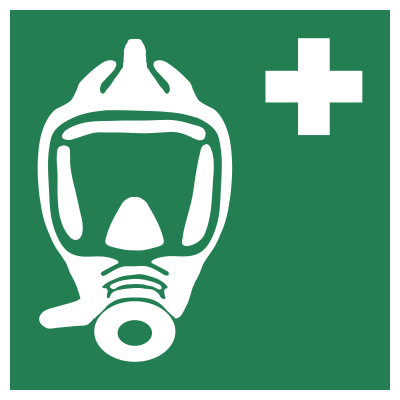 EEBD A mask or hood with an air supply of at least 10 minutes. It serves ONLY for escaping from a compartment with a dangerous atmosphere, never for fighting the fire.
 Detection and alarm
Detectors, alarms and the fire control plan: a fire must first be seen.
 Fixed fire detection and fire alarm system The system combines smoke, heat and flame detectors with manually operated call points. When it picks up signs of fire, the signal goes to the control station. Fire control plan The permanent diagram of the ship with the placement of all fire equipment and systems, control stations, divisions and escape routes. The copy for the shore fire brigade waits in a red container at the entrance to the superstructure.
 Structure and escape
"A", "B" and "C" class divisions, dampers in the ventilation and escape routes: the ship divided so a fire cannot travel.
 Means of escape Designated, marked and lit routes from every part of the ship straight to the muster station or the embarkation station.
 Drills and surveys
Practice alarms and annual servicing: regular drills and inspections are what readiness is made of.
Content based on SOLAS Chapter II-2 and the International Code for Fire Safety Systems (FSS Code); every figure was verified against the source texts. Figures that depend on the particular ship are deliberately omitted. This is not a legal text: when in doubt, the current wording of the Convention decides.