Portable fire-fighting equipment
Portable fire extinguishers
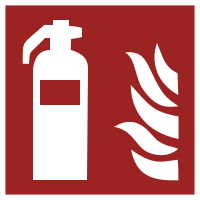
The first response to a small fire. The type of extinguisher is matched to the class of fire that can start in the given space.
Key facts
- Dry powder and CO2 extinguishers hold at least 5 kg of agent, foam ones at least 9 litres. A whole portable extinguisher weighs at most 20 kg.
- For class A fires, a dry powder extinguisher from 4 kg and a water (mist) one from 6 litres count as equivalent to the 9-litre foam extinguisher.
- The choice depends on the space: accommodation, class A; galleys, class B and F/K; control stations, class A plus an agent for electrical equipment; machinery spaces, class B plus the electrical agent; open decks and ro-ro spaces, class B.
- Every extinguisher has a sealed pin or another indicator that shows whether it has been used.
- Only approved refill charges for the given type may be used for recharging.
Technical parameters
- Dry powder / CO2
- at least 5 kg of extinguishing agent
- Foam
- at least 9 l of extinguishing agent
- Total mass of a portable extinguisher
- not more than 20 kg
- Equivalent for class A
- dry powder from 4 kg, water (mist) from 6 l
Watch out
The number and placement of extinguishers in particular spaces follow IMO circular MSC.1/Circ.1275. We do not quote those numbers here, because they depend on the ship.
How it looks in practice
- Extinguishers hang in the alleyways, at the stairways and on several levels of the engine room. How many and where exactly: that is what the fire control plan shows.
- The crew checks them weekly and monthly with checklists. On ships with a third officer this is usually their job, together with the rest of the life-saving and fire-fighting equipment.
- Once a year an approved company takes the extinguishers ashore for service or replaces them with new ones. The trace stays on the equipment: the station’s sticker with the date.
From the deck: sea practice, not regulation. Details vary with the ship and the owner.
Legal basis
FSS Code chapter 4; European standards EN 3-7 and EN 1866-1; placement per IMO MSC.1/Circ.1275.
This is not a legal text: when in doubt, the current wording of the Convention and the FSS Code decides.
Related STCW training
Fire prevention and fire fighting (STCW A-VI/1-2).