Single-letter signals: cheat sheet A to Z
Single-letter signals are the code’s most urgent and most common messages: one flag carries a whole sentence. Below are all the letters with their meanings; click a code to open the full flag page with the pronunciation, the Morse sign and real-life use.
| Flag | Code | Name | Meaning |
|---|---|---|---|
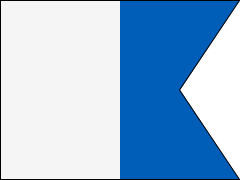 | A | Alfa | I have a diver down; keep well clear at slow speed. |
 | B * | Bravo | I am taking in, or discharging, or carrying dangerous goods. |
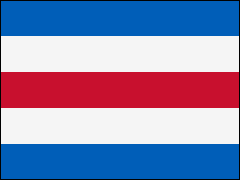 | C * | Charlie | Yes (affirmative or "The significance of the previous group should be read in the affirmative"). |
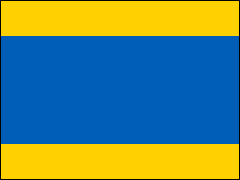 | D * | Delta | Keep clear of me; I am maneuvering with difficulty. |
 | E * | Echo | I am altering my course to starboard. |
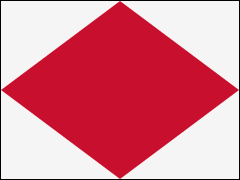 | F | Foxtrot | I am disabled; communicate with me. |
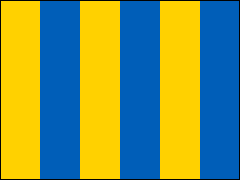 | G * | Golf | I require a pilot. When made by fishing vessels operating in close proximity on the fishing grounds it means: "I am hauling nets". |
 | H * | Hotel | I have a pilot on board. |
 | I * | India | I am altering my course to port. |
 | J | Juliett | I am on fire and have dangerous cargo on board: keep well clear of me, or I am leaking dangerous cargo. |
 | K | Kilo | I wish to communicate with you. |
 | L | Lima | You should stop your vessel instantly. |
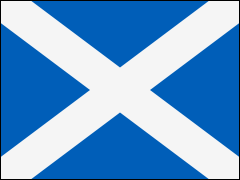 | M | Mike | My vessel is stopped and making no way through the water. |
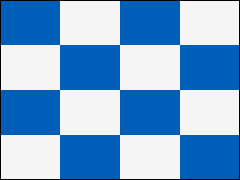 | N | November | No (negative or "The significance of the previous group should be read in the negative"). This signal may be given only visually or by sound. For voice or radio transmission the signal should be "NO". |
 | O | Oscar | Man overboard. |
 | P | Papa | In harbor: All persons should report on board as the vessel is about to proceed to sea. At sea: It may be used by fishing vessels to mean: "My nets have come fast upon an obstruction". It may also be used as a sound to mean: "I require a pilot". |
 | Q | Quebec | My vessel is "healthy" and I request free pratique. |
 | R | Romeo | No single-letter meaning (in procedures: acknowledgement of receipt, "Received"). |
 | S * | Sierra | I am operating astern propulsion. |
 | T * | Tango | Keep clear of me; I am engaged in pair trawling. |
 | U | Uniform | You are running into danger. |
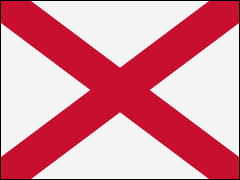 | V | Victor | I require assistance. |
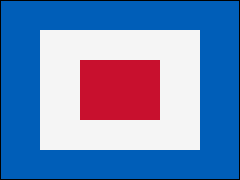 | W | Whiskey | I require medical assistance. |
 | X | X-ray | Stop carrying out your intentions and watch for my signals. |
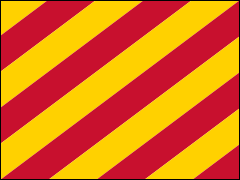 | Y | Yankee | I am dragging my anchor. |
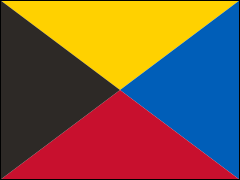 | Z * | Zulu | I require a tug. When made by fishing vessels operating in close proximity on the fishing grounds it means: "I am shooting nets". |
How to read this table
- The meanings are quoted 1:1 from Pub 102 International Code of Signals (public domain).
- The asterisk (*) marks the signals B, C, D, E, G, H, I, S, T and Z: when made by SOUND they may only be made in compliance with the collision regulations (COLREGs). By flag or light there is no such restriction.
- K and S additionally have special meanings as landing-place signals for small boats with survivors (SOLAS, chapter V).
- The letter R is the only one with no single-letter meaning: in communications it plays a procedural role (acknowledgement of receipt).
Icebreaker signals
During ice assistance these signs have ONLY the meanings below and are made by sound, visual signalling or radiotelephone. The group WM opens the assistance, WO closes it.
| Sign | Icebreaker | Assisted vessel |
|---|---|---|
| WM ·−− −− | Icebreaker support is now commencing. Use special icebreaker support signals and keep continuous watch for sound, visual or radiotelephone signals. | Same both ways: a common group, it opens the assistance. |
| WO ·−− −−− | Icebreaker support is finished. Proceed to your destination. | Same both ways: a common group, it closes the assistance. |
| A ·− | Go ahead (proceed along the ice channel). | I am going ahead (I am proceeding along the ice channel). |
| G −−· | I am going ahead; follow me. | I am going ahead; I am following you. |
| J ·−−− | Do not follow me (proceed along the ice channel). | I will not follow you (I will proceed along the ice channel). |
| P ·−−· | Slow down. | I am slowing down. |
| N −· | Stop your engines. | I am stopping my engines. |
| H ···· | Reverse your engines. | I am reversing my engines. |
| L ·−·· | You should stop your vessel instantly. | I am stopping my vessel. |
| 4 ····− | Stop. I am icebound. | Stop. I am icebound. |
| Q −−·− | Shorten the distance between vessels. | I am shortening the distance. |
| B −··· | Increase the distance between vessels. | I am increasing the distance. |
| 5 ····· | Attention. | Attention. |
| Y −·−− | Be ready to take (or cast off) the towline. | I am ready to take (or cast off) the towline. |
| ··−·· ··−·· | Stop your headway (given only to a ship in an ice channel, ahead of the icebreaker, approaching or moving away from it). A special signal, not a letter. It is not transmitted by radiotelephone. | I am stopping my headway. |
- The signal K by sound or light reminds ships of their obligation to keep a continuous radio listening watch.
- With several assisted ships, keep the distances between them as constant as possible. Watch your own speed and the ship ahead; when your speed drops, sound the attention signal to the ship astern.
- Using these signals does not release any ship from complying with the International Regulations for Preventing Collisions at Sea.
Keep going
- All signal flags: the search box, numerals and substitutes.
- Flags quiz: check how many meanings you remember.
- Interactive mast: build a hoist from flags.